
Digital Inclusion Whanganui’s First Principles provide a practical framework for how we make decisions, set priorities and approach our work. They help keep the mahi grounded in purpose, equity, evidence, safety, accountability and local experience.
What we mean by digital inclusion
Digital inclusion means people should be able to connect, learn and stay safe online, with the right support when cost, confidence, disability or location gets in the way.
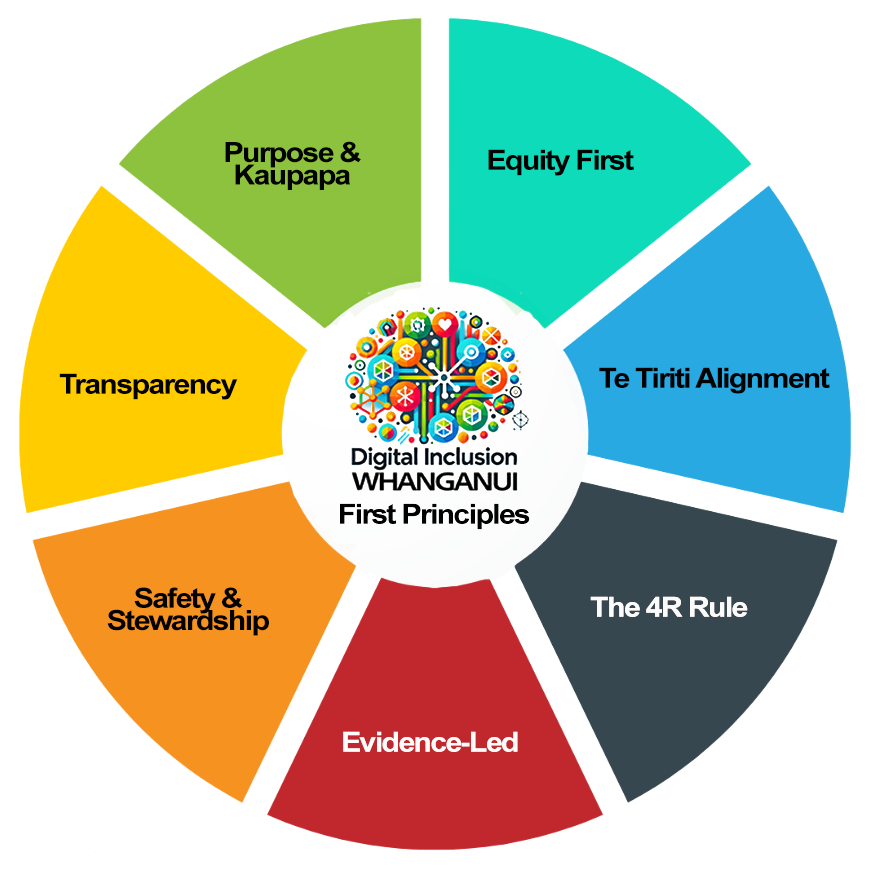
Our First Principles
Purpose & Kaupapa
We exist to reduce digital exclusion in Whanganui so people can live, work and connect with confidence.
Equity First
We focus effort where barriers are greatest and where the potential benefit is highest.
Te Tiriti Alignment
Partnership, participation and protection guide how we show up, how we work and who we work with.
The 4R Rule
We ask four questions: Right Focus? Right Message? Right Regulator? Right Outcome? This helps us identify where an issue sits and where action can make the greatest difference.
Evidence-Led
We test assumptions, use local insight and wider evidence, and share what we learn when it is ready.
Safety & Stewardship
We help keep people safe online and handle information and data with care, consent and appropriate boundaries.
Transparency
We say what we are trying, what worked, what did not and what we are learning — while protecting the privacy of individuals.
From principles to practice
These principles guide how Digital Inclusion Whanganui decides where to put effort, how to approach practical work and research, and how to assess what we learn. They provide a consistent framework without pre-determining particular programmes, partners or solutions.
The framework is intended to remain useful as the work develops: grounded in local experience, open to evidence and learning, and able to evolve when experience shows that something needs to change.